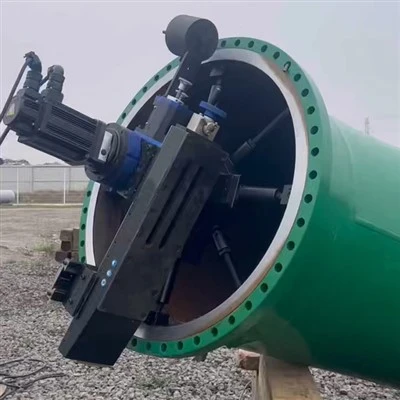
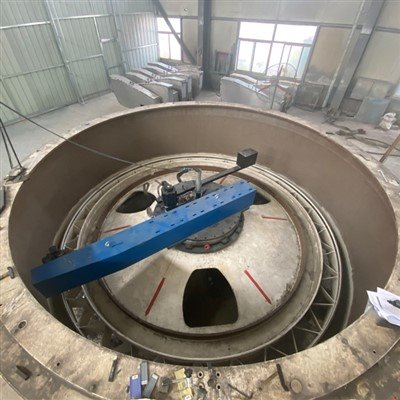
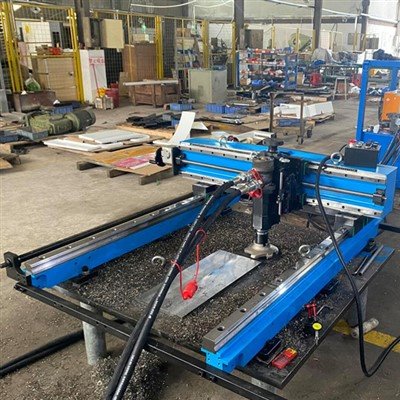
Thanks to their flexibility and efficiency, portable end-shaft lathes have become indispensable tools across a wide range of applications. However, for engineers and users alike, a fundamental dilemma persists: how can one pursue portability without compromising machining precision? Underlying this challenge lies a complex interplay of technical trade-offs and ingenious design solutions across multiple dimensions.
Material Selection: The Tug-of-War Between Lightweighting and Strength
To ensure rigidity, traditional lathes typically utilize heavy cast iron or steel-materials that run counter to the very concept of "portability." Portable end-shaft lathes, conversely, often opt for high-strength aluminum alloys or carbon fiber composites. Aluminum alloys possess a density just one-third that of steel and, following heat treatment for strengthening, can adequately meet basic cutting rigidity requirements. Carbon fiber materials offer even more remarkable advantages; not only are they lightweight, but they also exhibit anisotropic mechanical properties, allowing for structural optimization tailored specifically to the direction of applied forces.
The Contradiction: The lighter the material, the more susceptible the structure becomes to deformation under cutting vibrations. The Solution: Employing topological optimization design to retain material thickness in critical load-bearing areas while hollowing out non-load-bearing zones to reduce weight. For instance, designing the lathe bed with a honeycomb or truss structure minimizes material usage while simultaneously maintaining overall structural rigidity.
The Drive System: A Battle to Preserve Precision Within a Compact Layout
To minimize physical dimensions, portable lathes frequently employ direct-drive motors or miniature servo systems. Compared to traditional belt or gear-driven mechanisms, these systems significantly reduce backlash and wear associated with intermediate transmission components. However, this approach introduces a new challenge: small motors possess limited torque capacity and may struggle to cope-or feel "underpowered"-when faced with heavy cutting loads, ultimately leading to a decline in machining precision.
The Balancing Strategy: Incorporating planetary gear reduction mechanisms to amplify torque within a confined space. This is paired with high-precision ball screws featuring nut assemblies where backlash can be controlled to within micron-level tolerances, thereby guaranteeing feed accuracy. For example, a specific model of portable lathe utilizes a dual-nut preloading technique to virtually eliminate axial backlash in the ball screw, achieving a positioning accuracy of 0.005 mm.
Structural Design: The Ingenuity of Folding and Modularity
To further enhance portability, some products feature folding lathe beds or adopt a modular design architecture. For instance, the lathe bed can be disassembled into two sections using quick-release bolts; similarly, the headstock and tailstock can be rapidly detached and, once packed into custom-fitted cases, transported with ease. However, frequent assembly and disassembly can easily lead to an accumulation of positional errors in the components, thereby compromising machining consistency.
The Solution: Critical components utilize a combination of high-precision dowel pins and tapered fits to ensure that positional error does not exceed ±0.01 mm during any assembly process. Concurrently, a laser calibration system has been introduced, allowing users to automatically compensate for errors with a single click after assembly, thereby restoring the machine's precision to its original factory specifications.
Manufacturing Process: The Difficult Trade-off Between Cost and Precision
High-precision machining can significantly enhance lathe performance, yet it inevitably entails skyrocketing costs. Take the spindle as an example: the cost of grinding-grade bearings is several times that of standard bearings, while the price gap between ultra-precision ground guide rails and standard milled rails is truly astronomical.
The Compromise: We adopted a strategy of "maximizing precision in core components while prioritizing practicality in auxiliary components." For instance, the spindle system spares no expense-incorporating ceramic ball bearings and an electric spindle-to guarantee rotational precision. Conversely, the lathe bed guide rails achieve micron-level flatness at a significantly lower cost through a process of precision hand-scraping, thereby striking an optimal balance between performance and cost.
The design of a portable end-shaft lathe is, in essence, an art form akin to "dancing in shackles." Every technological breakthrough represents a redefinition of the delicate balance between portability and precision. In the future, as new materials and manufacturing processes continue to evolve and iterate, this inherent conflict may finally find its ultimate resolution.