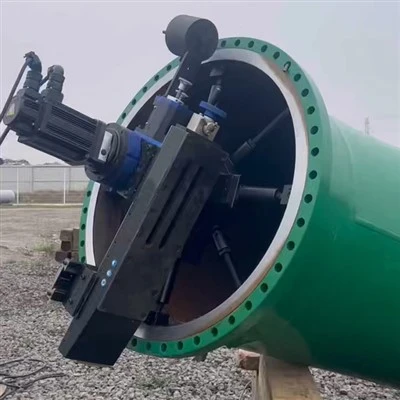
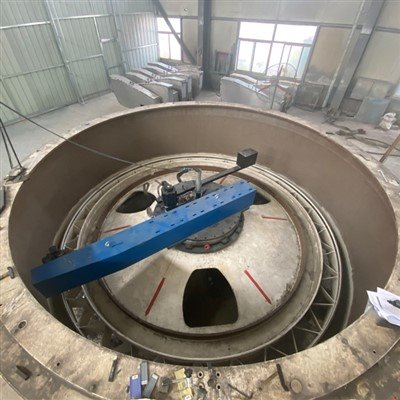
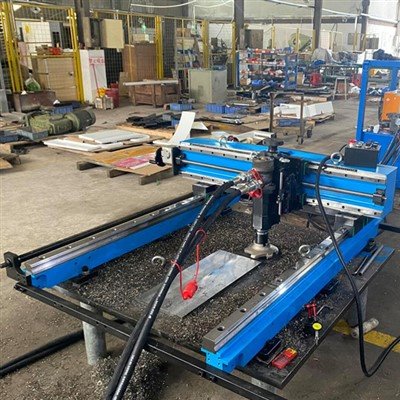
In the field of machining operations, line boring is an indispensable precision machining process, widely applied across heavy equipment, shipbuilding, steel mill, construction machinery, and other industries. The precision result of boring directly determines the operational stability and service life of the equipment for machining and repairing holes in large or heavy parts.
Today, we will thoroughly analyze boring, from its basic definition to its working principle and practical applications, guiding you to quickly master this key machining technology. We'll also explore how portable machining equipment can break through the limitations of traditional machining and achieve efficient on-site processing.
① What is Line Boring?
In short, line boring operation is a machining method that features a portable line boring machine to enlarge, refine, or repair existing holes on a workpiece.
Its core purpose is to improve dimensional accuracy, shape accuracy, and positional accuracy of the hole, while optimizing the surface roughness to meet the stringent requirements of equipment assembly and operation. It can improve the precision of newly machined holes and repair worn or deformed existing holes, restoring them to their original performance.
With the continuous upgrading of industrial operation and maintenance needs, line boring operations have gradually shifted from traditional fixed workshop machining to on-site machining. The emergence of portable boring machines has completely solved the machining problem of large and heavy parts that are unable to be moved to the worksho.
Our portable line boring equipment are small, lightweight, and detachable. And they can quickly reach the work site to efficiently complete various hole machining and repair tasks, significantly improving processing efficiency and effectively reducing transportation and disassembly costs.
② Why is Boring Needed?
In the process of mechanical manufacturing and equipment operation and maintenance, the necessity of boring is mainly reflected in two core scenarios: new part machining and old part repair. The core requirements of these two scenarios are "accuracy standards" and "performance stability."
First, about the machining of new bores on the parts of heavy equipment:
Many critical components of heavy equipment, such as rolling mill stands, ship stern shaft seats, and engine blocks, have large-sized holes with high precision requirements. the ordinary machining method is not able to carry out because of its large or irregular size.
Next, about the machining of existing bores:
Heavy equipment operates in high-temperature, high-load, and high-impact environments for extended periods. these core components including ship stern shaft holes and heavy equipment bearing holes are prone to wear, ellipticity, and taper deformation. It is costly fees and longer equipment downtime if these components are replaced directly.
In such cases, The kind of on-site machining equipment for bore repair can precisely remove the wear layer, restore the original precision of the hole, and allow for the reuse of old parts. This reduces maintenance cost and shortens downtime. Especially for boring operations on heavy equipment, traditional workshop machining method requires disassembling and transporting heavy components, which is time-consuming and labor-intensive.
However, our portable boring machines can complete the repair directly on-site, offering a significant advantage.
③ How Line Boring Machines Work?
The working principle of a boring machine is actually quite simple, the core being "rotary cutting + precise feed" - through the relative movement of the tool and the work piece, excess material is removed from the hole wall, thereby achieving precision machining or repair of the hole. Specifically, it can be divided into three key steps.
The first step is clamping and positioning. The boring bar has to remain coaxial and central in the bores by using positioning accessories such as set up cones and calipers. This is fundamental to ensuring boring accuracy. For on-site boring operations, portable line boring tools can be quickly clamped using adjustable stands, eliminating the need for extensive work piece disassembly. They are also adaptable to machining holes of different sizes and positions, offering exceptional flexibility.
The second step is tool adjustment. Based on the size and accuracy requirements of the hole, adjust the boring bar's extension length, cutting angle, and cutting parameters to ensure precise cutting of the hole wall while avoiding chipping, scratches, and other problems. Our portable boring machines are equipped with adjustable tool assemblies to adapt to different hole diameters, making operation convenient and eliminating the need for tedious adjustments by professional personnel.
The third step is the cutting process. The cutting edge of the tool gradually removes excess material from the hole wall until a hole meeting the requirements is machined. During the machining process, the boring machine uses a precision control system to adjust the rotation speed and feed rate in real time to ensure that the dimensional accuracy, shape accuracy, and surface roughness of the hole all meet the standards.
For large hole machining scenarios such as boring heavy equipment and boring ship stern shaft holes, portable boring machines can further improve machining accuracy and stability through auxiliary accessories such as ID mounting kit and laser alignment.
④ Typical Applications of Line Boring
Because of its high precision and high adaptability, our portable line borer machine is widely used in the manufacturing and maintenance of heavy equipment in various industries. The typical applications are as following:
1. Line Boring for Heavy Equipment:
Mainly used for the machining and repair of heavy components such as steel mill rolling mill stands, bearing holes in mining machinery, and spindle holes in machine tools. These components are large and heavy, making them impossible to move to a workshop for processing. Our (JDA's) field machining equipment can be taken to job sites directly for repairing these holes, avoiding secondary damage and cost waste caused by disassembly and transportation, and significantly reducing equipment downtime.
2. Line Boring for Ships:
The stern shaft hole is a core position of the ship's propulsion system. The long-term immersion in seawater makes it prone to wear, corrosion, and elliptical deformation, directly affecting navigational safety. The stern shaft hole repair can be performed directly on the hull during ship docking by our on site line boring machine. Our in situ boring machine helps a lot in enhancing maintenance efficiency and reducing repair cost.
3. Line Boring for Construction Machinery:
Hydraulic cylinder holes and pin holes of construction machinery including excavators, cranes, and loaders are subjected to high-load impact over long periods, leading to wear and scoring easily. Our portable in situ boring machine can repair these holes at these locations on-site, quickly restoring the operational performance of the construction machinery, avoiding prolonged downtime due to component replacement, and improving construction efficiency.
4. General Machining:
Our portable inline boring machines also can be used for precision machining of components including engine blocks, gearbox housings, and gearbox bores,etc. in machine manufacturing workshops, ensuring that the hole accuracy meets assembly requirements and guaranteeing stable equipment operation. Portable boring machines can also serve as on-site machining equipment to address temporary machining and emergency repair needs in the workshop, improving production flexibility.
So line boring is a core process in precision machining and equipment maintenance. The widespread applications of portable boring machines has broken the spatial limitations of traditional machining method, making on-site boring and heavy equipment boring operations more efficient and convenient.
Our portable line bore machine plays a crucial role across various industries, whether it's used for precision machining of new parts or the repair and reuse of old parts. It is capable of reducing costs, improving efficiency, and ensuring stable equipment operation.
Contact JDA team today to get product catalogue of portable line boring machine series.