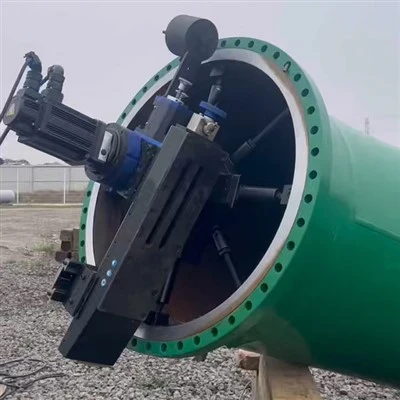
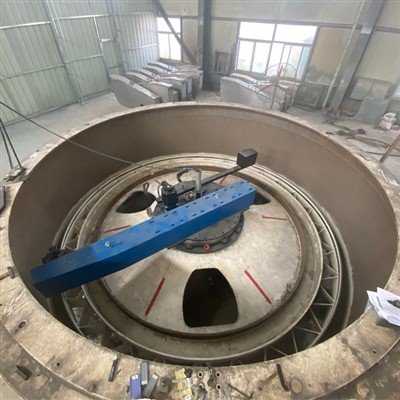
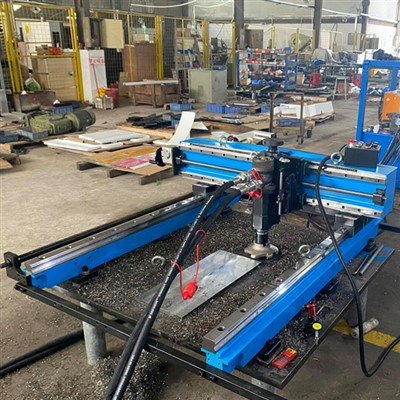
In the realm of industrial machinery maintenance, integrated boring and welding machines have emerged as a highly popular piece of equipment in recent years. Many professionals specializing in machine tool restoration and heavy equipment repair have gradually adopted them as their primary tool. Many might wonder: is a single device that combines two functions truly more convenient than using separate boring machines and welders? Today, let's discuss the practical advantages of integrated boring and welding machines in industrial maintenance applications.
First and foremost, the key advantage of an integrated boring and welding machine lies in its unified operation, which saves a significant amount of time and effort that would otherwise be spent on back-and-forth maneuvering. Industrial maintenance sites frequently encounter situations where equipment components are worn or cracked-such as the pin holes in an excavator's boom or the bucket articulation points on a loader. Repairing these faults typically requires first boring out the worn section to restore its geometry, followed by welding to reinforce the area or fill in missing material. If one were to rely on traditional, separate equipment, the boring machine would first need to be transported to the site, set up, and calibrated; once boring is complete, it would have to be dismantled and removed to make way for the welder, which then requires transport, wiring, and preheating. This process not only wastes time but also necessitates repeated repositioning of the workpiece, making it highly susceptible to precision errors. In contrast, the integrated boring and welding machine consolidates both functions into a single unit; a single setup allows for the completion of both boring and welding operations, drastically reducing the time spent on equipment handling and calibration, thereby significantly boosting maintenance efficiency.
Secondly, integrated boring and welding machines boast exceptional adaptability, enabling them to handle a wide variety of complex maintenance scenarios. Industrial maintenance environments vary greatly-ranging from indoor workshops to outdoor construction sites-and some components are simply too large and heavy to be transported to a fixed processing area. Most integrated boring and welding machines feature a compact design and a relatively lightweight body, often equipped with flexible mobility mechanisms. This allows them to be easily transported and positioned precisely where needed, whether in a cramped workshop corner or on a muddy construction site. Furthermore, their operational scope is highly flexible: they can handle everything from small bushing holes and flange bores to large-scale frame bores and cylinder block bores. The welding function is equally versatile, capable of meeting the requirements of various materials-such as standard carbon steel and alloy steel-eliminating the need to acquire and deploy multiple specialized welding units.
Finally, and crucially, integrated boring and welding machines offer superior assurance regarding maintenance precision. In traditional, separate-step operations-where welding follows boring-the need for secondary fixturing often leads to part misalignment, thereby compromising assembly quality. In contrast, an integrated boring and welding machine completes both processes in a single setup; this ensures that the part's reference position remains consistently aligned, allowing for precise control over both boring accuracy and weld placement. Consequently, the repaired component fits seamlessly with the original equipment, minimizing complications during subsequent assembly. Furthermore, many integrated boring and welding machines are equipped with sophisticated control systems capable of real-time adjustments to boring speed and feed rate, as well as welding current and voltage. This enhances the overall stability of the repair process and helps prevent quality issues stemming from human error during manual operation.
Of course, integrated boring and welding machines do present certain considerations. For instance, the operational barrier is slightly higher than that of a single-function machine, as operators must possess proficiency in both boring and welding techniques; additionally, routine maintenance requires attending to the upkeep of both functional modules simultaneously. Nevertheless, when viewed holistically, the advantages of such integrated systems-particularly in terms of boosting repair efficiency, ensuring precision, and adapting to complex operational scenarios-remain undeniably significant.
As the industrial maintenance sector continues to demand ever-higher levels of efficiency and precision, integrated equipment like the boring and welding machine is poised to play an increasingly vital role across a wider spectrum of repair applications. For professionals engaged in industrial machinery maintenance, selecting the right integrated boring and welding machine not only serves to alleviate their workload but also elevates the professionalism and quality of their repair services.