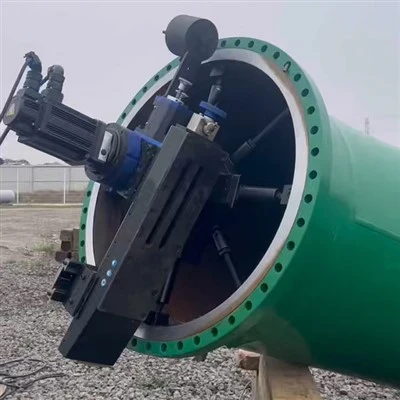
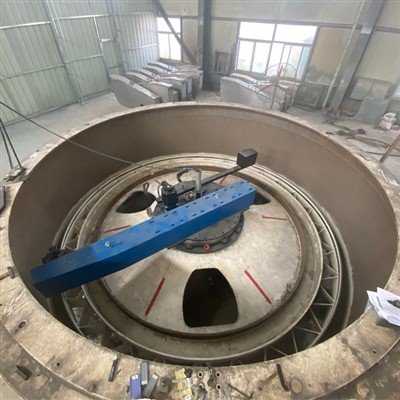
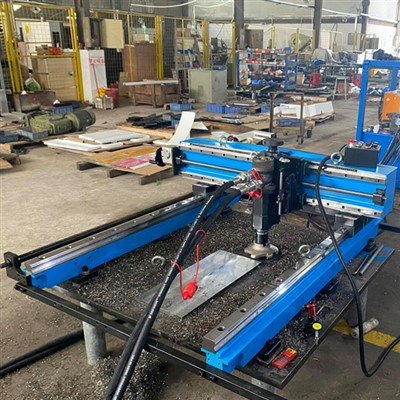
In industries such as heavy machinery, petrochemicals, and shipbuilding, the planar positions of large equipment (such as rolling mill stands, equipment bases, and flange faces) are subjected to high temperatures, high loads, and high impacts for extended periods, making them prone to wear, deformation, and corrosion, directly affecting the equipment's operational accuracy and stability.
The traditional milling method in workshops requires disassembling and transporting heavy components, which is time-consuming, labor-intensive, and prone to secondary damage, failing to meet the needs of on-site emergency repairs and efficient machining. Against this backdrop, our portable milling machines have emerged as a core on site machining equipment, providing the optimal solution for on-site milling of planar surfaces.
We will break down the market demand for on-site milling of planar surfaces, the types of portable milling machines, typical application industries, and processing advantages in this article, helping industry practitioners gain a comprehensive understanding of this core equipment.
① Market Demand for On-site Milling Machining of Planar Surfaces
With the transformation of industrial operations and maintenance towards higher efficiency and convenience, the market demand for on-site milling of planar surfaces, with core demands concentrated in three main scenarios.
First, there's emergency equipment repair. The wear and deformation of large equipment's planar positions directly impacts production capacity due to downtime. Enterprises urgently need processing equipment that can quickly reach the site without disassembling parts, enabling rapid repair and production recovery.
Second, there's the processing of large components. Many heavy equipment components are large and heavy, making disassembly and transportation to the workshop impossible. On site milling machine is necessary to reduce transportation and disassembly costs.
Third, In some on-site assembly scenarios, fine-tuning milling of planar surfaces is required to ensure assembly accuracy. Traditional fixed milling machines cannot meet the demands of flexible operations.
Furthermore, the increasing demands for processing accuracy and efficiency across industries are further driving the market demand for portable milling machines and other on-site processing equipment, expanding the application scenarios for on-site milling machines.
② The Types of Portable Milling Machine
Our portable milling machines, as the mainstream on-site milling machines, are mainly divided into two core types based on their structural characteristics and processing scenarios. These types adapt to different sizes and scenarios for on-site milling jobs, and are highly complementary, covering the vast majority of on-site flat machining scenarios.
The first type is the portable linear milling machine, which emphasizes miniaturization and flexibility. It is small size and lightweight, allowing for quick assembly, disassembly, and transport. It is suitable for milling small to medium-sized planes, and is particularly well-suited for complex working environments such as confined spaces and high-altitude locations, such as milling and repairing small equipment bases and flange faces. It is convenient to operate, no requiring special lifting equipment.
The second type is the portable gantry milling machine, which adopts a gantry structure, offering high rigidity and stability. It is suitable for large-area plane surface milling jobs, such as rolling mill stands, ship decks, and large equipment bases. It can achieve precise milling of large-area planes. It can improve processing efficiency and meet the high-precision machining requirements of heavy equipment.
Furthermore, based on processing functions, portable milling machines can also be divided into plane milling machine, portable keyway milling machine, etc., further expanding the adaptability range for on-site processing.
③ Typical Applied Industries of Portable Milling Machine
Our, JDA's Portable milling machines, with their advantages of flexibility, efficiency, and precision, are widely used in many industrial fields, becoming the core equipment for on-site plane milling jobs.
The typical applied industries mainly fall into four categories.
First, in the heavy machinery industry, portable gantry milling machines are used for milling the bases and guide rails of mining machinery and metallurgical equipment, as well as for on-site repairs of rolling mill stands. They can precisely process large flat surfaces, avoiding losses from component disassembly.
Second, in the shipbuilding and marine engineering industry, portable linear milling machines and portable gantry milling machines are used during ship dry-docking to mill the planes of ship main engine bases and deck machinery bases, repairing worn parts without disassembling heavy components, significantly improving dry-docking efficiency.
Third, in the petrochemical industry, on-site milling machines are used for milling the flange faces of reactors and heat exchangers, as well as equipment connection planes. They can complete on-site processing and repair without affecting production, avoiding the risk of media leakage.
Fourth, in the power industry, on-site milling is used for the planes of turbine and generator bases to ensure equipment installation accuracy, guarantee stable operation of power equipment, and can also be used for emergency maintenance of power plant equipment, shortening downtime.
④ Advantages of Portable Milling Machine
On-site milling operation of flat surfaces by our portable milling machines offers significant advantages, perfectly solving many pain points of traditional processing. First, it is highly efficient and convenient. Our portable milling machines can quickly reach the work sites without the need to disassemble or transport heavy components. Installation and debugging are simple, and small-scale surface machining takes only a few hours, significantly reducing downtime and productivity loss.
Second, it is precise and stable. On-site milling machines (especially portable gantry milling machines and portable linear milling machines) are equipped with precision positioning devices, effectively ensuring the flatness and surface finish of the surface, meeting the requirements of equipment assembly and operation.
Third, it is cost-effective. It eliminates the costs of component disassembly, transportation, and hoisting, and allows for the repair and reuse of old components, significantly reducing maintenance costs, especially suitable for the machining and repair of large and heavy components.
Fourth, it has a strong adaptability. Our portable milling machines are small and detachable, flexibly handling complex work scenarios such as high altitudes, confined spaces, and outdoor environments. Whether it's a small surface or a large surface area, it can efficiently complete milling operations, adapting to the diverse needs of different industries.
In summary, the market demand for on-site milling of planes continues to expand with the upgrading of industrial operations and maintenance. Portable milling machines, as core on-site milling machines, are divided into portable linear milling machines and portable gantry mill machines, and are widely used in industries such as heavy machinery, shipbuilding, and petrochemicals.
With their advantages of high efficiency, precision, low cost, and high adaptability, they have completely broken through the limitations of traditional workshop processing, becoming the preferred field machining equipment for on-site plane machining and providing strong support for the safe and stable operation of industrial equipment.
Contact JDA sales today to get versatile mobile milling machine for milling machining jobs.