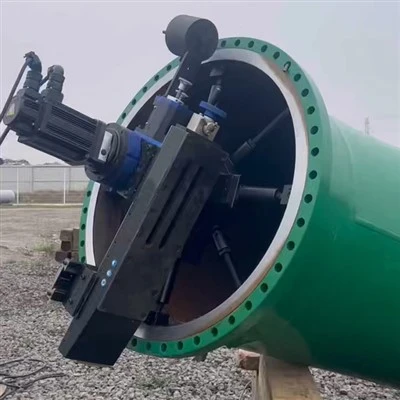
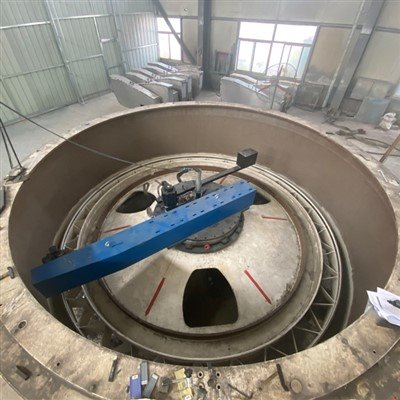
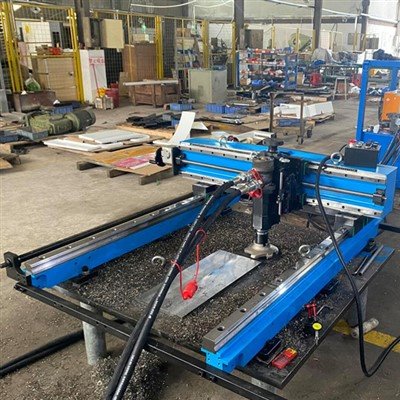
In the fields of construction machinery, agricultural equipment, and mining machinery maintenance, integrated boring and welding machines have emerged as essential tools for on-site bore repair. Thanks to their ability to perform *in-situ* repairs without requiring the complete disassembly of the machine, they are widely utilized for restoring components such as excavator boom eyes, loader boom pin bores, frame articulation bores, and bearing seats. However, during actual operations, welding defects-specifically porosity and slag inclusions within the bore-present a common challenge for many maintenance technicians. This issue not only compromises weld density and bonding strength but also leads to uneven bore walls and dimensional inaccuracies following subsequent boring operations. Consequently, the service life of the repaired component is significantly shortened, often necessitating costly and time-consuming rework. To completely eliminate such welding defects, meticulous attention must be paid to every stage of the process-from preliminary preparation and operational execution to process control.
Preliminary workpiece preparation serves as the foundation for preventing porosity and slag inclusions, yet it is a step that is frequently overlooked. Before initiating a surfacing operation with an integrated boring and welding machine, the worn internal bore must undergo a thorough cleaning process. This entails completely removing any rust, mill scale, oil stains, grit, and residual grease from the bore wall surface. Under the high temperatures generated during welding, rust and mill scale can release harmful gases; if these gases become trapped within the molten pool as it cools, they result in porosity. Conversely, oil stains and other impurities directly lead to slag inclusions, causing the deposited weld layer to become porous or discontinuous. For effective cleaning, one should first use a steel brush or sandpaper to abrade surface impurities, followed by wiping with a specialized degreaser. Finally, a heat gun should be used to thoroughly dry any moisture within the bore, ensuring the welding area is clean and dry, thereby eliminating the root causes of potential defects.
Precise control over welding parameters and techniques is absolutely critical; equipment settings must be appropriately adjusted based on the workpiece material and the dimensions of the bore. When performing surfacing operations with an integrated boring and welding machine, it is essential to select the appropriate wear-resistant welding wire. The use of substandard or moisture-laden wire must be strictly avoided; any wire that has absorbed moisture must be thoroughly dried prior to use. Furthermore, the welding current and voltage must be neither excessively high nor excessively low. An excessively high current generates excessive heat within the molten pool, leading to metal spatter and preventing the timely escape of gases. Conversely, an excessively low current results in an insufficient molten pool depth, preventing impurities from floating to the surface and making the formation of slag inclusions highly probable. It is recommended to employ a layered, segmented, and constant-speed internal bore buildup welding process. The thickness of each individual weld layer should not be excessive; upon the completion of each layer, the slag on the weld bead surface must be promptly removed before proceeding to the next layer. This allows sufficient time for gases and impurities within the weld pool to rise and escape, thereby ensuring that the deposited layer is dense and uniform.
Furthermore, protective measures for the field construction environment are of paramount importance. Integrated boring and welding machines typically operate in open-air construction sites or remote field locations, where airflow, wind-blown sand, and rain can all adversely affect weld quality. During field operations, it is necessary to erect simple windbreaks and rain shelters to prevent direct airflow from impinging on the welding zone, thereby avoiding the entrapment of air within the weld pool that could lead to porosity. Additionally, throughout the welding process, the angle between the welding torch and the bore wall must be kept stable, and the torch moved at a constant speed to prevent interruptions or skips in the weld, ensuring that the weld bead is continuous and smooth. Upon completion of the buildup welding, boring operations should not be initiated immediately; instead, the workpiece should be allowed to cool naturally to avoid rapid quenching, which could lead to weld cracking or latent porosity issues. By adhering to these meticulous operational procedures throughout the entire process, issues such as porosity and slag inclusions in internal bore buildup welds can be effectively avoided, ensuring that the bore walls repaired by the integrated boring and welding machine are dense and wear-resistant. This restores the component's original operational performance and extends the equipment's maintenance cycle.